Ebook subscription models allow readers to access a wide range of digital content, including ebooks, audiobooks, comics, and magazines, for a recurring fee. Schools and libraries increasingly use these services, though costs and screen fatigue remain concerns.
Revenue for 2025 is projected at US$14.92 billion.
Subscription platforms account for over 50% of ebook revenue.
The Subscription and Ebook Models book industry now leverages data analytics for better content curation.

Key Takeaways
https://amzn.to/45NcAKG
Ebook subscription services provide unlimited access to a wide range of digital content for a fixed monthly fee, making reading more affordable and convenient.
Authors can earn income through page reads in subscription models, but they should be aware of potential contractual ambiguities that may affect their earnings.
The ebook subscription market is rapidly growing, driven by increased smartphone usage and a rising demand for digital content, presenting opportunities and challenges for libraries and publishers.
Ebook Subscription Services and Models
Ebook subscription services have transformed how readers, schools, and libraries access digital content. These platforms offer a wide range of formats, including ebooks, audiobooks, comics, magazines, and even podcasts. Many services, such as Kobo Plus and Scribd, provide access to graphic novels and children’s books. Libraries and educational institutions use these subscription models to meet diverse reading needs and manage budgets efficiently.
Unlimited Access Subscriptions
Unlimited access allows users to read or listen to as many titles as they want without restrictions. This subscription model is popular among general interest readers, genre enthusiasts, and children’s clubs. Leading providers include ProQuest, Kobo Plus, Everand, and StoryTel.
| Company | Description | Titles Offered |
|---|---|---|
| ProQuest | Multidisciplinary scholarly ebooks | Over 700,000 titles |
| Kobo Plus | Wide range of ebooks in 21 countries | N/A |
| Everand | Millions of ebooks, audiobooks, magazines | Several million titles |
| StoryTel | Audiobooks and ebooks with unlimited access | N/A |
Some ebooks allow unlimited use, enabling multiple users to access the same title at once. DRM-free ebooks offer even more flexibility, letting users copy, print, and download without restrictions.
Limited/Quota-Based Subscriptions
Limited or quota-based ebook subscription services restrict the number of titles a user can access each month. Some models set one- or three-user limits, while others use concurrent or non-linear access, capping the number of uses per year. Libraries often use these models to control costs and ensure fair access for all patrons.
Note: Libraries face challenges with the loss of perpetual access rights in some subscription models, so they diversify acquisition strategies to align with budget constraints.
Hybrid Subscription Models
Hybrid subscription models combine unlimited access with quota-based features. Schools and libraries may use evidence-based acquisition or demand-driven acquisition, allowing them to curate content and respond to actual usage. Publishers and libraries collaborate closely, gathering feedback from librarians and adjusting content curation schedules to minimize disruption. Advisory meetings help shape the development of ebook subscription services, ensuring relevance and inclusivity.
Ebook subscription services continue to evolve, offering readers and institutions flexible ways to access a growing variety of digital content.
How Digital Book Subscription Services Work
https://amzn.to/4jMJmkP
User Experience and Access
Digital book subscription services offer a streamlined experience for readers. Users begin by signing up for an account, often through a website or app. After registration, they can browse a vast catalog of ebooks, audiobooks, comics, and magazines. The platforms provide search tools and recommendations to help users find titles that match their interests.
A typical service supports multiple devices, such as smartphones, tablets, computers, and dedicated e-readers. For example, Kobo allows users to read directly on their e-reader without a browser. Storytel provides offline access and personalized recommendations. 24 Symbols gives access to a large catalog across different devices. Kobo Plus lets users switch between reading and listening.
Tip: Many platforms offer family profiles, making it easy for several users to share one subscription.
The following table highlights key features that shape the user experience:
| Feature | Description |
|---|---|
| Content breadth and relevance | Services offer titles for academic, leisure, and professional needs. |
| Pricing and licensing models | Subscription tiers are flexible, with clear rules for sharing and offline access. |
| Platform compatibility | Users can access content on smartphones, tablets, desktops, and e-readers. |
| Integration capabilities | Some platforms integrate with learning management systems or library tools. |
| Data privacy & security | Providers use strong measures to protect user data and follow regulations. |
| Customer support & training | Assistance and onboarding resources help users get started and solve problems. |
Digital access remains a priority for these services. Providers focus on accessibility features, such as adjustable fonts, audio narration, and support for multiple languages. These features ensure that readers of all ages and abilities can enjoy digital content.
Payment and Royalty Systems
Payment structures for digital book subscription services vary. Most platforms offer monthly or yearly plans, and some use a freemium model. The freemium model gives users basic access for free, with options to upgrade for more features. This approach helps engage new users before they commit to a paid plan.
| Plan Type | Monthly Price | Yearly Price |
|---|---|---|
| Free Trial | Free | N/A |
| Single Author | $12 | $120 |
| Collaboration | $40 | $400 |
| Subscription Model | Description |
|---|---|
| Monthly Subscription | Users pay a recurring fee every month for access to the service. |
| Yearly Subscription | Users pay a recurring fee once a year, often at a discounted rate. |
| Freemium Model | Basic access is free, with upgrades for more features or content. |
Royalty systems reward authors based on engagement and sales. On Kindle Unlimited, authors earn royalties according to the number of pages read. Amazon uses the Kindle Edition Normalized Page Count (KENP) to ensure fair compensation. Audible tracks listening time, and royalties depend on content consumed and subscription type.
| Platform | Royalty Structure | Notes |
|---|---|---|
| PublishDrive | 100% royalties with monthly fee | Authors retain full earnings |
| Basic Plan | 70% royalties on ebooks | For ebooks priced at $2.99 and above |
| Pro Plan | 85% royalties | Higher earnings for Pro plan authors |
| Pricing below $2.99 | 45% royalties | Lower earnings for cheaper ebooks |
Authors receive payments based on user engagement, such as pages read or listening time.
Amazon allocates a global fund each month and distributes it according to total engagement.
The engagement payment rate determines how much each audiobook earns.
These systems encourage authors to produce high-quality content that attracts and retains readers.
Licensing and Content Availability
Licensing agreements play a major role in determining which ebooks and other digital content are available. Academic and library platforms use different models. Clarivate/ProQuest is moving to a subscription-only model, phasing out one-time perpetual licenses by 2025. This change responds to libraries’ needs and the rise of AI-driven content discovery. EBSCO continues to offer perpetual access and flexible acquisition models, giving libraries more choices.
| Vendor | Title Availability | Licensing Model | Notes |
|---|---|---|---|
| Vendor 1 | High | 100-circulation model | Competitive pricing, some bargains |
| Vendor 2 | High for audiobooks | Pay-for-use | Lacks 2-year option for some titles |
| Vendor 3 | Lower | Newer model | Exclusive access to desirable titles, lower costs |
| Vendor 4 | Limited | Pay-for-use | Not expanded in Canada, known for sustainability issues |
“Most readers don’t know that the thousands of libraries offering access to ebooks don’t actually own that digital content themselves, the way they do the physical books on their shelves. That can limit libraries’ ability to preserve content, update the formats when needed, share the content with other libraries and transfer the content when they change systems.” — John S. Bracken, DPLA Executive Director
Several factors influence content availability in digital book subscription services:
Licensing complexities shape which titles are offered.
Regional regulations require services to adapt their catalogs.
Localized content ensures relevance for different audiences.
Acquisition costs can limit the range of available titles.
Platform scalability supports a growing user base and content library.
User engagement strategies help retain subscribers.
Copyright laws and data privacy regulations, such as GDPR and CCPA, affect content and user data.
Censorship policies restrict certain titles in some regions.
Partnerships with publishers expand the variety of content.
Technological advancements improve delivery and accessibility.
Digital access depends on these licensing models and agreements. Libraries and institutions must balance cost, flexibility, and long-term access when choosing a subscription service. The ebook market continues to evolve, with providers adapting to changing needs and regulations.
Subscription and Ebook Models Book Industry Trends

Reader Benefits: Cost, Convenience, Variety
Many readers choose subscription and ebook models book industry options because they offer cost savings and convenience. With a subscription service, users pay a fixed fee and get unlimited access to thousands of ebooks, audiobooks, and even early access to new releases. Readers enjoy a wide variety of genres and receive personalized recommendations based on their interests.
Ebook subscription services provide budget-friendly options, allowing readers to access numerous titles for a fixed fee.
Readers can enjoy unlimited access to books without incurring additional costs, making it a cost-effective choice.
The convenience of instant access to a wide array of titles enhances the reading experience.
Ebook subscription services, such as Kindle Unlimited and Scribd, provide users with access to a vast library of titles for a monthly fee. This model encourages readers to explore more books, leading to an increase in reading frequency and fostering greater customer loyalty.
Publisher and Author Impact
https://amzn.to/4jMrqHf
The subscription and ebook models book industry has changed how publishers and authors earn money. A subscription service like Kindle Unlimited gives authors new ways to earn income, especially in popular genres. Authors can receive payments based on page reads, and some earn most of their income from these services. However, some authors and publishers worry about unclear contracts and lower payments compared to traditional sales. They want clear recommendations and fair terms to protect their rights.
Ebook subscription models like Kindle Unlimited provide alternative income sources for authors and publishers.
Authors can earn significant income through page reads in KU, especially in genres such as romance and fantasy.
Authors and publishers are concerned about ambiguous contractual terms that can lead to financial losses.
Market Growth and Challenges
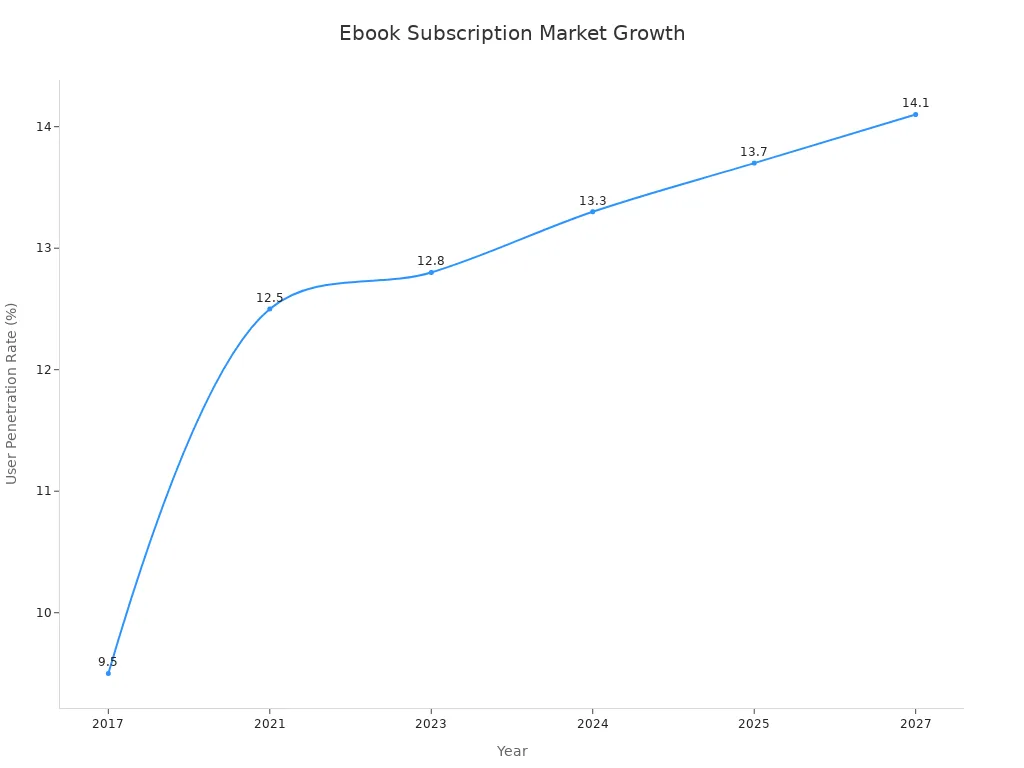
The subscription and ebook models book industry is growing quickly. More people use smartphones and tablets, making it easier to join a subscription service. The demand for digital content keeps rising, and online education uses more ebooks. The chart below shows how user penetration rates have increased:
| Factor | Evidence |
|---|---|
| Smartphone and Tablet Penetration | Global smartphone users projected to reach 7.1 billion, enhancing access to eBooks. |
| Demand for Digital Content | Global digital content market expected to reach $550 billion, with 62% of readers preferring digital formats. |
| Growth of Online Education and E-Learning | Online education sector projected to grow to $400 billion, with 75% of institutions integrating digital resources. |
Some challenges remain. Libraries must adapt as they lose perpetual licenses and move to a subscription book service. They need recommendations for new strategies to keep supporting education and research. The subscription and ebook models book industry will continue to change as technology and reader preferences evolve.
The strategic implementation of these tools fosters long-term subscriber loyalty and supports the sustainability of book subscription models.
Ebook subscription models continue to grow because they offer variety, convenience, and cost savings. Readers enjoy unlimited access and personalized recommendations. Publishers and authors adapt to new strategies. Key trends include mobile reading, sustainability, and interactive content. The industry will keep evolving as technology shapes how people discover and enjoy books.
FAQ
What are the best online book subscription services for readers who want personalized recommendations?
Many readers choose the best online book subscription services that use data to offer personalized recommendations and tailored book recommendations based on reading history and preferences.
How do ebook platforms create personalized reading experiences?
https://pinardpublishing.com/transform-your-mornings-with-a-science-backed-routine-for-emotional-fitness/
Ebook platforms use algorithms to analyze reading habits. They deliver personalized suggestions, personalized recommendations, and tailored book recommendations to help readers discover new titles that match their interests.
Can students benefit from personalized features in ebook subscriptions?
Students receive personalized reading lists and personalized recommendations. These features help them find books for school projects or leisure, making learning more engaging and efficient.
Conclusion
As we conclude our exploration of trending ebook and subscription models, it is clear that these innovative approaches are reshaping the landscape of digital reading and educational content delivery. By offering flexibility, accessibility, and personalized experiences, these models cater to the diverse needs of today’s learners and professionals. As educators and knowledge enthusiasts, embracing these trends can enhance our learning journeys and skill development efforts. Whether it’s through a curated ebook collection or a dynamic subscription service, the opportunity to expand our horizons and deepen our understanding is at our fingertips. With the continuous evolution of these models, the future of reading and learning promises to be more engaging and enriching than ever before.